
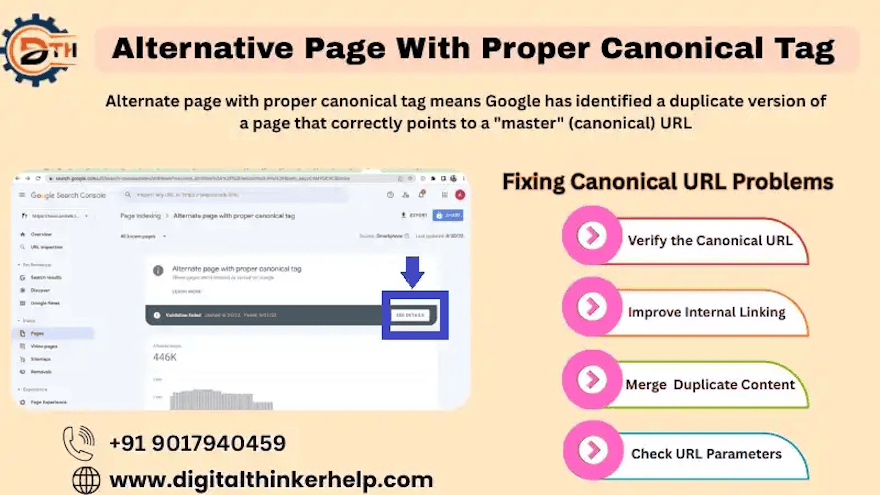
When working on your website’s SEO, you might notice the ‘Alternate Page with Proper Canonical Tag’ status in Google Search Console.
Although it may look about at first, this message is usually informational and does not mean there’s a serious problem with your site.
In this guide, we’ll clearly explain what this status means, why Google shows it, and how to handle it the right way to save your SEO healthy.
What Does “Alternate Page with Proper Canonical Tag” Mean?
The “Alternate Page with Proper Canonical Tag” status let showing in Google Search Console. This means Google has found multiple versions of a page, but has correctly found the main (canonical) URL to index. The duplicate version gets ignoring.
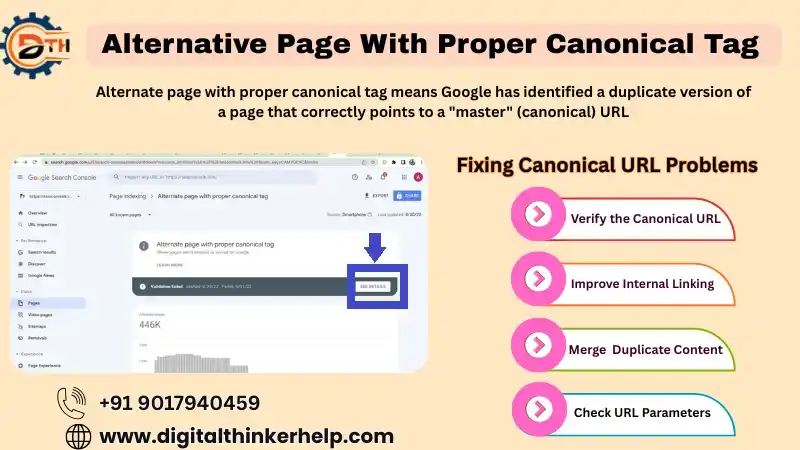
This usually specifies everything is working as expected, and no instant action is needs because Google understands which page must rank.
However, it’s still a good idea to review these pages occasionally to ensure the correct URLs are canonical. Otherwise, you must miss out on valuable traffic alike pages that deserve to be indexing.
How to Fix the “Alternate Page with Proper Canonical Tag” Status?
Here’s how you are capable of properly solving the “Alternate Page with Proper Canonical Tag” status to support and improve your overall SEO performance, especially if you are managing or working with a Web Devlopment Company In India that handles large and complex websites.1) Must be identify if Your Pages get Properly Canonicalized
Start by making sure the canonical tags on your pages point to the correct, preferred URL. You capable of use Google Search Console’s URL check tool to review which URL Google study canonical.
To view the “Alternate page with proper canonical tag” report, open Google Search Console, go to Indexing → Pages, then scroll to “Why pages are not indexed” and select “Alternate page with proper canonical tag.”
If you find that a page is using the wrong canonical URL, update it immediately. This helps prevent ranking signals alike start split and ensures the correct page receives full SEO value.
2) Checking if Specific Pages Should Be Indexing
Not every page on your website needs to looks in search results. Some pages are more valuable like SEO and visibility, while others do not add much value.
Review the alternate pages marked with a proper canonical tag and decide whether they must be indexing by Google. If a page is not important like search traffic, applying a no- index tag is a smart choice.
Like example, internal search result pages, duplicate product pages, or other low value pages usually don’t need indexing.
Using the no-index tag helps Google focus on your most important pages, improves crawl organization, and build up final SEO performance.
3) Using WordPress Plugins to Update Canonical Tags
Using popular WordPress plugins like Yoast SEO or Rank Math build it easy to manage canonical URLs directly alike your WordPress dashboard. These tools are capable of also be connecting with Google Search Console like better tracking and control.
With their user friendly interface and built in automation, you capable of update canonical tags without touching complex HTML code. This not only saves time but also reduces the risk of mistakes that must negatively affect your SEO.
4) Check if Your Internal Link Structure Needs Changes
Your internal links help search engines know your website structure and decide which pages must be use as canonical. If links point to the wrong page type, Google are confused around which URL to rank.
To avoid this, affect a site audit and make sure all internal links point to the right canonical URLs. Tools like SEMrush, Ahrefs, and Screaming Frog capable of help you quickly find and fix internal linking issues, make sure proper canonicalization and stronger SEO signals.
5) Checking for Crawl Budget Problem
Crawl budget refers to the number of pages Google bots capable of crawl on your website within a stated time. If many pages have missing or incorrect canonical tags, Google may spend time crawling low value pages instead of your most important ones.
To stop this, make sure all canonical tags are properly set. You capable of track crawl activity in Google Search Console to confirm that your important pages are start crawled and indexed efficiently, helping improve final SEO performance.
6) Delete Unwanted Canonical Tags
While canonical tags are useful, overusing them capable of weaken your SEO efforts. If your website has a clean structure and no duplicate content issues, adding canonical tags everywhere may not be needing.
Review your existing canonical tags carefully. If few tags do not serve a clear purpose, removing them capable of clarify, your site structure, reduce confusion like search engines, and help improve final SEO performance.
7) Apply 301 Redirects
Now, a 301 redirect is a good mix than a canonical tag like duplicate content.
A 301 divert every time moves a page to a new URL, so both users and search engines are cursorily sent to the updated page. In difference, a canonical tag only signals the choose URL to search engines without redirecting visitors.
Use canonical tags like duplicates you like to save, but if you like a new URL to replace an old one and pass SEO value alike the old page, a 301 redirect is the more effective choice.
8) Update Your Sitemap
A well fresh sitemap helps Google find and index the right pages on your website. After updating your canonical tags, make sure to refresh your sitemap so it show these changes.
Include only the URLs you like indexed and remove any pages that canonicalize to other URLs. Then, submit the updated sitemap to Google Search Console to make sure proper crawling and indexing of your important pages.
9) Regular Monitor GSC for Issues
SEO is an in progress process, not a onetime task. Daily check Google Search Console to stay updated on any issues similar to your canonical tags.
Set up alerts in Google Search Console so you are notified now if new problems with canonical tags are finding.
Early detection allows you to fix issues quickly, stopping them alike negatively affecting your site’s performance.
Addressing the “Alternate Page with Proper Canonical Tag” status may seem minor, but doing it correctly capable of positively impact your rankings in search results.
Best Practices to Prevent Future Issues
Consistent URL Structures: Save your URLs clean and standardized. Avoid uncalled query parameters or duplicate versions to build it easier like search engines to understand your site.
Canonical Tags: Set proper canonical tags on all pages to clearly specify the choice type to search engines.
XML Sitemaps: Use tools like AIOSEO to involve the only canonical URLs in your sitemap. This helps stop alternate or duplicate URLs alike start indexed extra.
Regular Audits: Periodically check your site’s indexing and canonical status using Google Search Console and tools like AIOSEO’s Search Statistics to finding and fix likely issues early.
Avoid Duplicate Content: Mix similar pages and use canonical tags or 301 redirects when needed to reduce content duplication and build up your SEO signals.
FAQs (Frequently Asked Quedtions)
What does “Alternative Page With Proper Canonical Tag” Mean?
This status means that Google start multiple similar or duplicate pages, and the page in question properly points to another URL as the canonical type.
Google has accepted the canonical tag and indexed the main page by choice.
- This is normal
- Not an error
Why is This Page not Indexed by Google?
Google believes that another page is the choose type based on the canonical tag and other part like internal links or content similarity.
Only the canonical page is indexed to stop duplicate content issues.
When Should You Fix or Change This Status?
You must be fix it only if:
- The page must be indexing separately
- The canonical URL is incorrect
- The page has unique, costly content
- If the canonical is correct, no action is needed.
Wrapping up
The “Alternate page with proper canonical tag” status usually means that your duplicate content gets handling correctly.
That said, canonicalization can be a tricky part of SEO, so reviewing the list of affected pages targeting Commercial Keywords can help you confirm that your canonical tags are applied properly across your site.